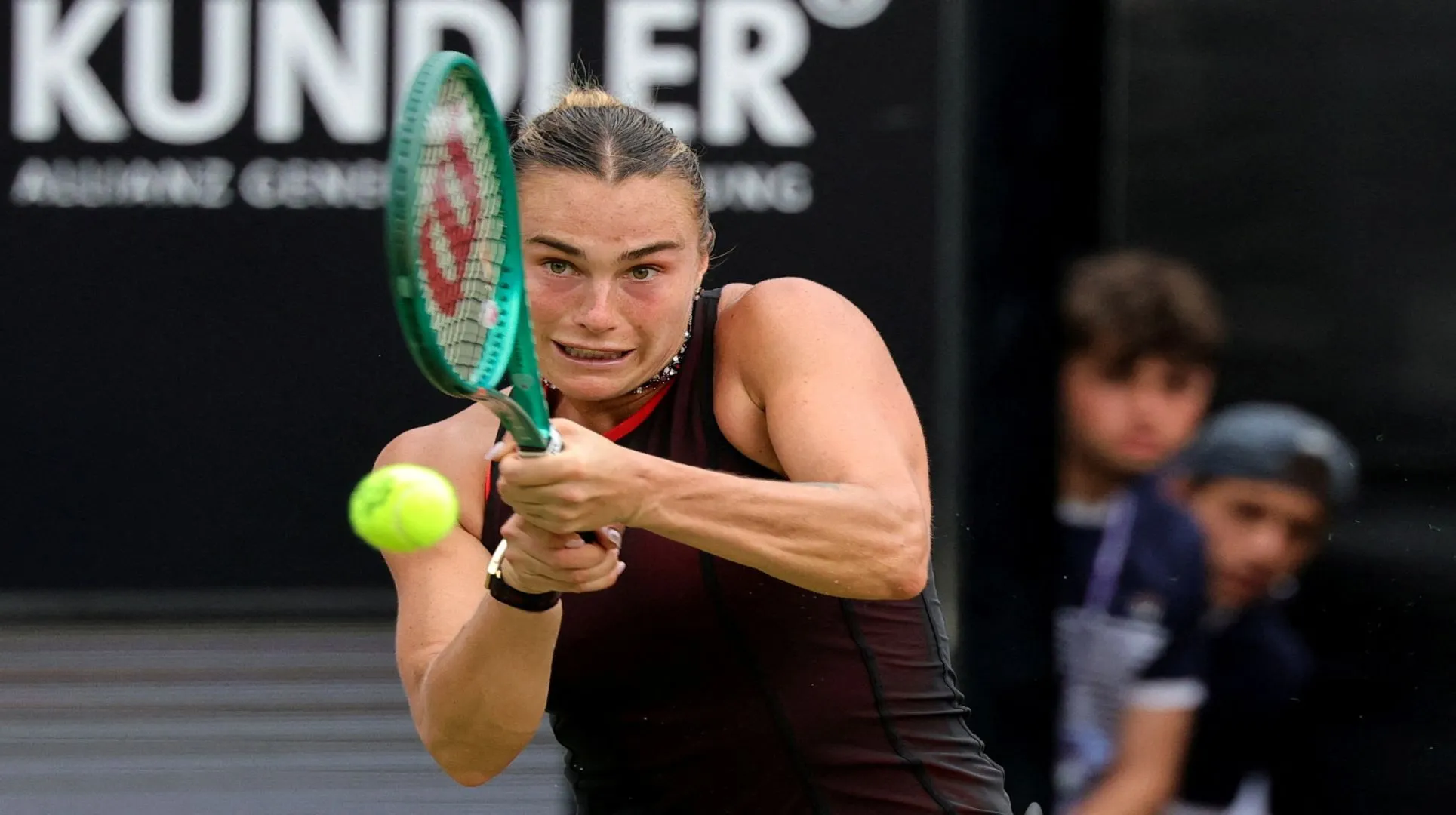
BENGALURU, June 24 (Reuters) - Aryna Sabalenka will carry the aftershocks of yet another Grand Slam meltdown into Wimbledon as the world number one comes under heightened scrutiny to show her nerve holds when the pressure spikes on the sport's biggest stage.
The 28-year-old Belarusian was two points from a place in the French Open semi-finals this month, before collapsing to a defeat by Russian outsider Diana Shnaider and later saying that she had descended into a "deep, dark hole" mentally.
The loss came a year after her runner-up finish at Roland Garros, where she let the title slip away, and again cast the spotlight on her 2022 decision to move on from a psychologist, though she has since revisited that step.
"I called my psychologist ... it felt like I needed to talk through everything I've been going through in the last, I don't know how many years," Sabalenka told tennis website Bounces during her run to the Berlin semi-finals this month.
"It was really helpful. I changed a lot of things and I'm trying a lot of new things now. I feel like I need to figure out what's happening, sometimes, in those matches to (be able to) move on and to avoid these situations happening."
MENTAL ENERGY
Wimbledon now presents a fresh test on grasscourts, where four-times major champion Sabalenka's raw power remains a major weapon, but her nerve will come under focus as pressure moments arrive more quickly on the sport's fastest surface.
Gustavo Granitto, an International Tennis Federation coach, said Sabalenka's competitive drive sometimes blurred her decision-making and sustaining a high level in pursuit of a Grand Slam demanded significant mental energy.
"Aryna is, first and foremost, a human being like any of us, yet also a competitive machine," Granitto, who is certified in the Gazing Red2Blue mindset framework used by some athletes, told Reuters.
"Perhaps her immense ambition to win, which is largely what makes her number one, combined with the intensity with which she 'lives' the match on court, can slightly distract her focus and judgment when making decisions."
'SLIPPERY SLOPE'
Former player and sports psychologist Jeff Greenwald said being as intense and emotionally wired as Sabalenka means there is often only one gear.
"This can become a slippery slope at the highest level as pressure increases, because if errors start mounting, it's hard to put the horse back in the barn," Greenwald added.
"It's not a regression but players do sometimes experience 'monkey on the back' syndrome if they can't secure a major for a long period, but that's not what's happened with her.
"She has had a great deal of success in the past few years to build on. Her turnaround was remarkable but again, when she focuses all of that intensity in a certain direction, she's likely to succeed."
HOW WILL SABALENKA BOUNCE BACK?
Sabalenka's last two defeats, at Roland Garros and Berlin, both ended in 6-0 deciding sets, pointing to an abrupt drop-off that has invited scrutiny of how her level holds up when matches slip from her grasp.
"I'm a little concerned about Sabalenka," ESPN commentator and former world number four Mary Joe Fernandez said.
"Her game translates to all surfaces. It should translate to grass with how powerful she hits the ball. She's got a weapon in the serve, weapon in the returns.
"What happened in Paris, she fell apart. The conditions got to her again ... she still struggles with it. Let's see how she bounces back.
"To me she's still the favourite to win Wimbledon, but not as clear of a favourite as a month ago."
You may be interested in
![Nike Men's Vomero 18 Road Running Shoes - White [HM6803-109]](https://d3lmgsai2rsy7d.cloudfront.net/astro-products/2026/05/25/6a140990e354f8.62743914-sg-11134201-820l8-mnfoteyofhu096)
Nike Men's Vomero 18 Road Running Shoes - White [HM6803-109]
![Nike Academy Team (30L) Football Backpack - Black [DV0761-011]](https://d3lmgsai2rsy7d.cloudfront.net/astro-products/2026/07/20/6a5d9bd674e625.29537053-sg-11134201-8259h-mqh22enzryteee)
Nike Academy Team (30L) Football Backpack - Black [DV0761-011]
![PUMA ULTRA 5 PLAY FG/AG Adult Spikes Apple Green Grass Football 10768903 [Le Mai.com]](https://d3lmgsai2rsy7d.cloudfront.net/astro-products/2026/05/25/6a1409975b2bf7.52020222-tw-11134207-7rash-m1o0n55dhn2j83)
PUMA ULTRA 5 PLAY FG/AG Adult Spikes Apple Green Grass Football 10768903 [Le Mai.com]
Luzz pickleball Paddle Pro 4 Tornazo Carbon Fiber Pickleball Paddle - Dual-Layer Core